Clinical Pathways
Ordered, protocol-driven sequences of care for a clinical condition.
Worked example: Sepsis Protocol (Adult, ED-Initiated)
A ten-category ontology for the "Operating System" layer of a hospital's design — clinical pathways, terminology, workflows, tasks, workforce, master data, policy, decision rights, logistics, and performance — instantiated end to end through one worked Sepsis Protocol pathway.
The source framing splits hospital design into two layers. This document models only the first.
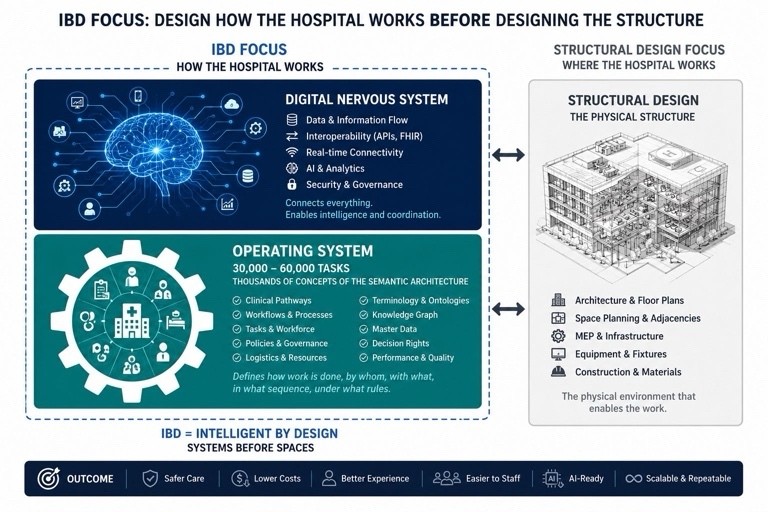
Digital nervous system (data flow, interoperability, connectivity, AI/analytics, governance) plus the operating model itself: clinical pathways, terminology & ontologies, workflows/processes, knowledge graph, tasks & workforce, master data, policies & governance, decision rights, logistics & resources, performance & quality. Defines how work is done, by whom, with what, in what sequence, under what rules.
Architecture & floor plans, space planning & adjacencies, MEP & infrastructure, equipment & fixtures, construction & materials — the physical environment that enables the work. Out of scope for this RDF mockup.
The framing behind this ontology traces to a LinkedIn thread on hospital operating-model design.
Everything in this document — the ten-category ontology, the Sepsis Protocol pathway instantiation, the Knowledge Graph Explorer — is an independently modeled RDF worked example inspired by the LinkedIn post and image below. It is not authored, reviewed, endorsed, or affiliated with Brian de Francesca, and it is not his forthcoming paper “The Hospital That Was Never Fully Designed.” Where his post is a thesis about operating-architecture design, this harness is a separate, agent-generated attempt to render that thesis as a concrete harness loosely coupled with a generated Knowledge Graph using mocked-up sample data only.
Brian de Francesca, on the cost of never fully designing a hospital's operating architecture: “Documentation should not be confused with design.” Full post: “Most hospitals were never fully designed” on LinkedIn.
On a related follow-up post (“Physical structures are derivative of operating systems…”), Kingsley Uyi Idehen commented:
“Yes, this is reality.”
“The question is: how is the problem solved?”
“Fundamentally, how is the map built without introducing compounding technical debt?”
This hospital-os-rdf-harness worked example is one attempt at an answer: model the pathway/task/policy “map” as RDF against a shared ontology rather than accreted documentation, so it can be extended (new pathways, new task instances) without re-deriving the schema each time. A threaded reply to this comment exists on LinkedIn but is gated behind sign-in and could not be retrieved for quotation here — see the reply thread on LinkedIn directly.
Each category is an RDF class in os:hospitalOS, rooted under the Knowledge Graph marker class, with one instance from the worked pathway shown as an example.
Models the ten operating-model concept categories (Clinical Pathways, Terminology & Ontologies, Workflows/Processes, Knowledge Graph, Tasks & Workforce, Master Data, Policies & Governance, Decision Rights, Logistics & Resources, Performance & Quality) and the relations that answer: what is done, by whom, with what, in what sequence, and under what rules. The source framing states this layer spans roughly 30,000–60,000 tasks and thousands of concepts hospital-wide; entities.ttl instantiates one representative pathway at illustrative scale, not the full inventory. Workflow/sequencing terms (ClinicalPathway, WorkflowStep, hasStep, nextStep) are cross-referenced via owl:equivalentClass/owl:inverseOf to the P-Plan ontology for interoperability with plan/step-modeling tools outside this corpus.
Ordered, protocol-driven sequences of care for a clinical condition.
Worked example: Sepsis Protocol (Adult, ED-Initiated)
Standardized clinical/operational terms binding pathways, tasks, and master data to a controlled vocabulary (skos:Concept).
Worked example: Sepsis (disorder)
Ordered stages of a pathway, each grouping the tasks performed at that stage.
Worked example: Triage & Recognition
The connective layer: every other category is rdfs:subClassOf this marker class, making every instance a graph node.
Worked example: Hospital Operating System Ontology
Discrete units of work, performed by workforce roles — the layer the source framing sizes at 30,000-60,000 tasks hospital-wide.
Worked example: Administer First Antibiotic Dose
Governed reference-data records a task reads or writes: patient charts, formulary items, order-catalog entries.
Worked example: Patient / EHR Record
Governance rules constraining how tasks, steps, or pathways may be carried out.
Worked example: Antibiotic Stewardship Policy
Authorities to make a specific class of decision, held by exactly one workforce role.
Worked example: Right to Escalate to ICU
Physical or schedulable resources — beds, equipment, stock — consumed or occupied by a task.
Worked example: IV Infusion Pump
Quality/performance measures, each with a target value and unit, evaluating a pathway or task.
Worked example: Time to First Antibiotic Dose
The pathway's own five ordered workflow steps, rendered as a HowTo — each step is simultaneously an os:WorkflowStep and a schema:HowToStep entity in the companion RDF.
Triage nurse performs qSOFA/SIRS screening against the patient record, governed by the sepsis screening policy.
Lab technician orders and draws serum lactate and pre-antibiotic blood cultures.
Pharmacist reviews the antibiotic order for stewardship (with override right in a Code Sepsis emergency); ED physician administers the first dose, measured against the time-to-antibiotics metric.
Triage nurse administers a 30 mL/kg IV fluid bolus, consuming the infusion pump and ED bed.
Lab technician repeats lactate and vital-sign reassessment; charge nurse exercises the ICU-escalation decision right under the critical care escalation policy.
Every workforce role, master-data record, resource, policy, decision right, metric, and terminology concept the sepsis pathway touches.
Rendered directly from the companion RDF (ontology.ttl TBox + entities.ttl ABox): 112 nodes, 230 edges, zero orphans. Click any node or edge label to open its full description via the URIBurner resolver.
Ten questions and answers, sourced directly from the companion RDF's schema:Question / schema:Answer entities.
In the source framing, the Knowledge Graph is the connective layer that indexes and links the other nine categories, not an isolated concept type sitting beside them. os:KnowledgeGraphComponent is therefore a marker rdfs:Class that every other category rdfs:subClassOf's, so any instance of any category is automatically a graph node.
os:hasTask/os:Task answers what is done; os:performedBy answers by whom; os:referencesMasterData and os:consumesResource answer with what; os:stepOrder and os:nextStep answer in what sequence; and os:governedByPolicy plus os:hasDecisionRight answer under what rules.
The source infographic states the Operating System layer spans roughly 30,000 to 60,000 tasks hospital-wide, across thousands of concepts. This worked example instantiates one pathway (9 tasks, os:estimatedAnnualTaskVolume 8,400 firings/year) as a representative sample, not the full inventory.
An os:ClinicalPathway is an ordered, protocol-driven sequence of care for a condition, composed of os:WorkflowStep instances via os:hasStep. This example's :sepsisPathway has five ordered steps from triage through escalation decision.
os:TerminologyConcept is declared rdfs:subClassOf skos:Concept, so every terminology instance can use skos:prefLabel, skos:notation, and skos:broader/skos:narrower directly rather than a bespoke vocabulary. The example's terminology codes (e.g. Sepsis (disorder)) are marked illustrative and not verified against a live terminology server.
An os:Policy is a governance rule that constrains how work is carried out; an os:DecisionRight is a specific authority to make a decision, held by exactly one workforce role via os:heldBy. A single task can be governed by a Policy and simultaneously require exercising a Decision Right — for example, antibiotic review is governed by the stewardship Policy while the physician separately holds the right to override its hold in a documented emergency.
os:measuredBy links a Task or ClinicalPathway to a os:PerformanceMetric, which carries os:metricTargetValue and os:metricUnit. The pathway-level metrics (time-to-antibiotics, lactate clearance, bundle compliance, 30-day mortality) roll up task-level measurement points into pathway-level quality evaluation.
Eleven terms from the companion RDF's schema:DefinedTermSet.