Overview
Seven stages of decoupling, one trajectory: experience set free from the application.
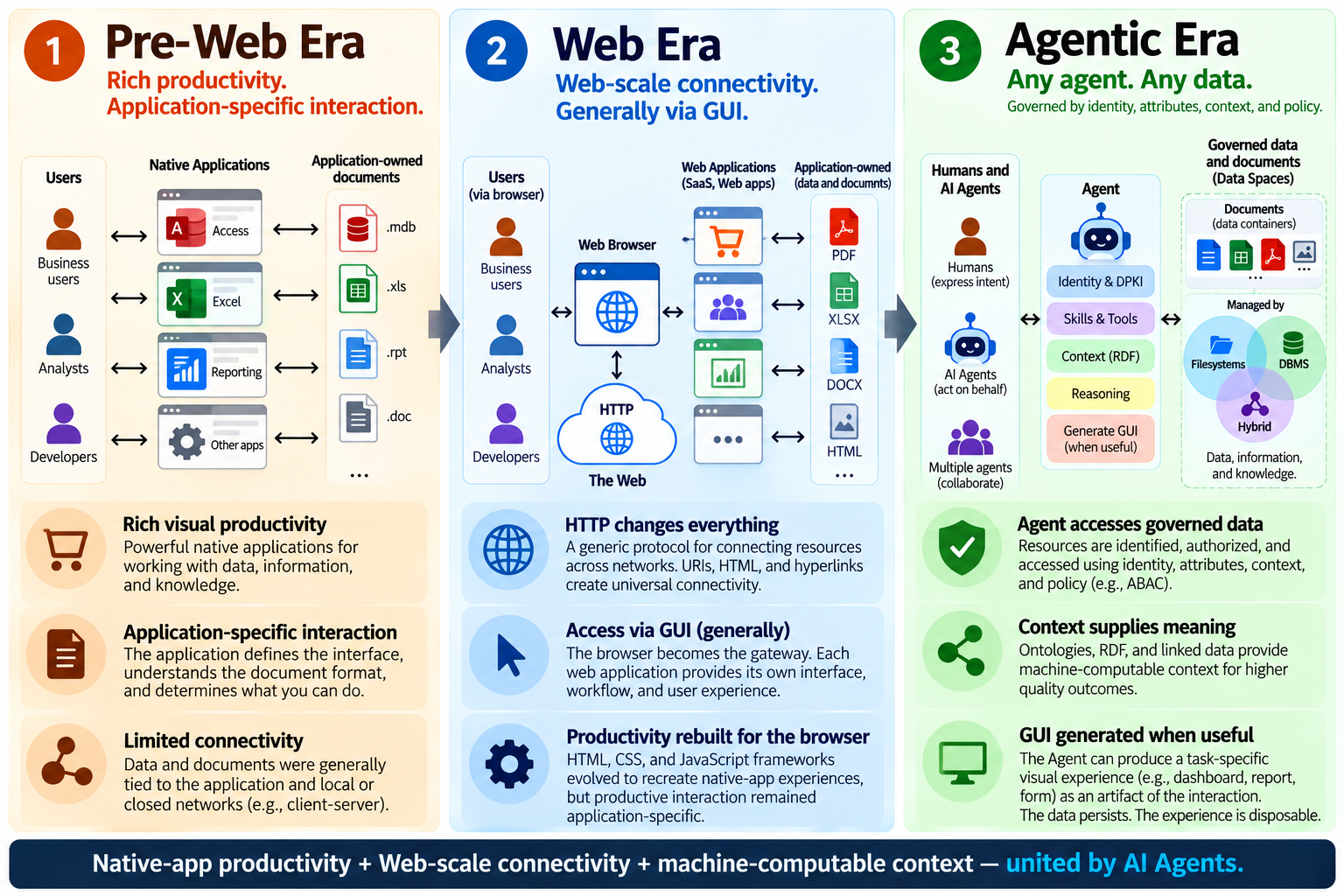
The essay opens with a confession anyone who lived through the nineties will recognize: software used to feel fast. On the Pre-Web desktop, applications were native, personal, and productive — because each one owned its files and understood its own content. The price of that richness was isolation. Every file format was a fiefdom, and moving work between programs meant export, import, and prayer.
Then came the Web, and with it the great trade. Anyone could reach anything — but only through the browser, and only through interfaces someone else had predetermined. The essay's sharpest phrase for this is the GUI moat: data wrapped in licensed, per-person, application-shaped surfaces, with technical debt compounding behind every screen. Connectivity went planetary; agency stayed local.
The Agentic era breaks the moat by decoupling the experience from the application. An agent works from intent: it reads governed data through ontologies, reaches tools through the Model Context Protocol, and generates the interface on demand. Northwind — the same sample database since the nineties — is the essay's proof: query it with an agent and the dashboard composes itself. That is escape velocity: not a faster GUI, but the moment the GUI stops being the price of admission.
ODBC
database management systemOpen Database Connectivity loosened the coupling between Windows applications and database management systems — the application no longer assumed which DBMS held the data.
UDBC / iODBC
operating systemOpenLink's UDBC took the ODBC API cross-platform without its Driver Manager and Administrator layers; Ke Jin developed those missing layers, and their fusion became iODBC — Unix, Linux, macOS, and beyond.
Java / JDBC
application runtime + database“Write once, run anywhere” attacked application-to-operating-system coupling, and JDBC brought database-independent connectivity into that portable application model.
CORBA
distributed object boundariesApplications needed loosely coupled access to capabilities across networked systems: Application → Object Interface → Distributed Capability.
HTTP
network location of resourcesThe Web's generic protocol delivered Web-scale connectivity — resources globally named by URIs, reachable across networks.
MCP
agent tool boundariesModel Context Protocol exposes capabilities as agent-accessible tools and resources: Agent → Tool Interface → Distributed Capability.
AI Agents
the predetermined GUIGiven identity, authorization, context, skills, and tools, agents act on intent — and generate the experience when visual interaction helps. The experience becomes disposable.
Three Eras
The same six dimensions, three eras apart. On wide screens the matrix; on phones, era cards.
| Aspect | Pre-Web Era | Web Era | Agentic Era |
|---|---|---|---|
| Connectivity | Confined — the application supplied the interface, understood the document format, and determined what the user could do. | Web-scale — HTTP, URIs, and hyperlinks made resources globally addressable. | Web-scale and operable — agents work directly with governed data and tools. |
| Productivity | Rich — Access, Excel, report writers, and native applications gave visual environments for working with data, information, and knowledge. | Regressed — no Web-native Access arrived; interface-making meant HTML, CSS, JavaScript, and programmer-centric frameworks. | Recovered — the agent generates a task-appropriate experience; the dashboard is an outcome, not a starting point. |
| Interaction model | Human → Application → Data — application-specific. | Human → GUI → Application → Data + Actions — the browser became the gateway. | Human → Agent → Governed Data + Tools → Actions — and, when useful, Agent → Generated Experience. |
| Who builds the experience | The application vendor. | A developer — the results could be excellent, but somebody still had to build them. | The agent — generated when visual interaction helps, disposable otherwise. |
| Access model | Application-specific pairing. | GUI-mediated, licensed per person. | Governed by identity, attributes, context, and policy — including ABAC. |
| Data representation | Documents and proprietary formats only the application understood. | An interconnected document network. | An interconnected entity-relationship graph — URIs, RDF, Linked Data, ontologies. |
Pre-Web Era
Confined — the application supplied the interface, understood the document format, and determined what the user could do.
Rich — Access, Excel, report writers, and native applications gave visual environments for working with data, information, and knowledge.
Human → Application → Data — application-specific.
The application vendor.
Application-specific pairing.
Documents and proprietary formats only the application understood.
Web Era
Web-scale — HTTP, URIs, and hyperlinks made resources globally addressable.
Regressed — no Web-native Access arrived; interface-making meant HTML, CSS, JavaScript, and programmer-centric frameworks.
Human → GUI → Application → Data + Actions — the browser became the gateway.
A developer — the results could be excellent, but somebody still had to build them.
GUI-mediated, licensed per person.
An interconnected document network.
Agentic Era
Web-scale and operable — agents work directly with governed data and tools.
Recovered — the agent generates a task-appropriate experience; the dashboard is an outcome, not a starting point.
Human → Agent → Governed Data + Tools → Actions — and, when useful, Agent → Generated Experience.
The agent — generated when visual interaction helps, disposable otherwise.
Governed by identity, attributes, context, and policy — including ABAC.
An interconnected entity-relationship graph — URIs, RDF, Linked Data, ontologies.
Northwind: One Database, Three Eras
The canonical sample database, played three ways — the article's concrete demonstration that experience can detach from the application.
Pre-Web Northwind
Rich, native, and trapped: only the app that owns the file understands its content.
Web Northwind
Reachable from anywhere, licensed per person, and locked behind a predetermined interface.
Agentic Northwind
The same Northwind, queried by intent — the dashboard is generated, not prebuilt.
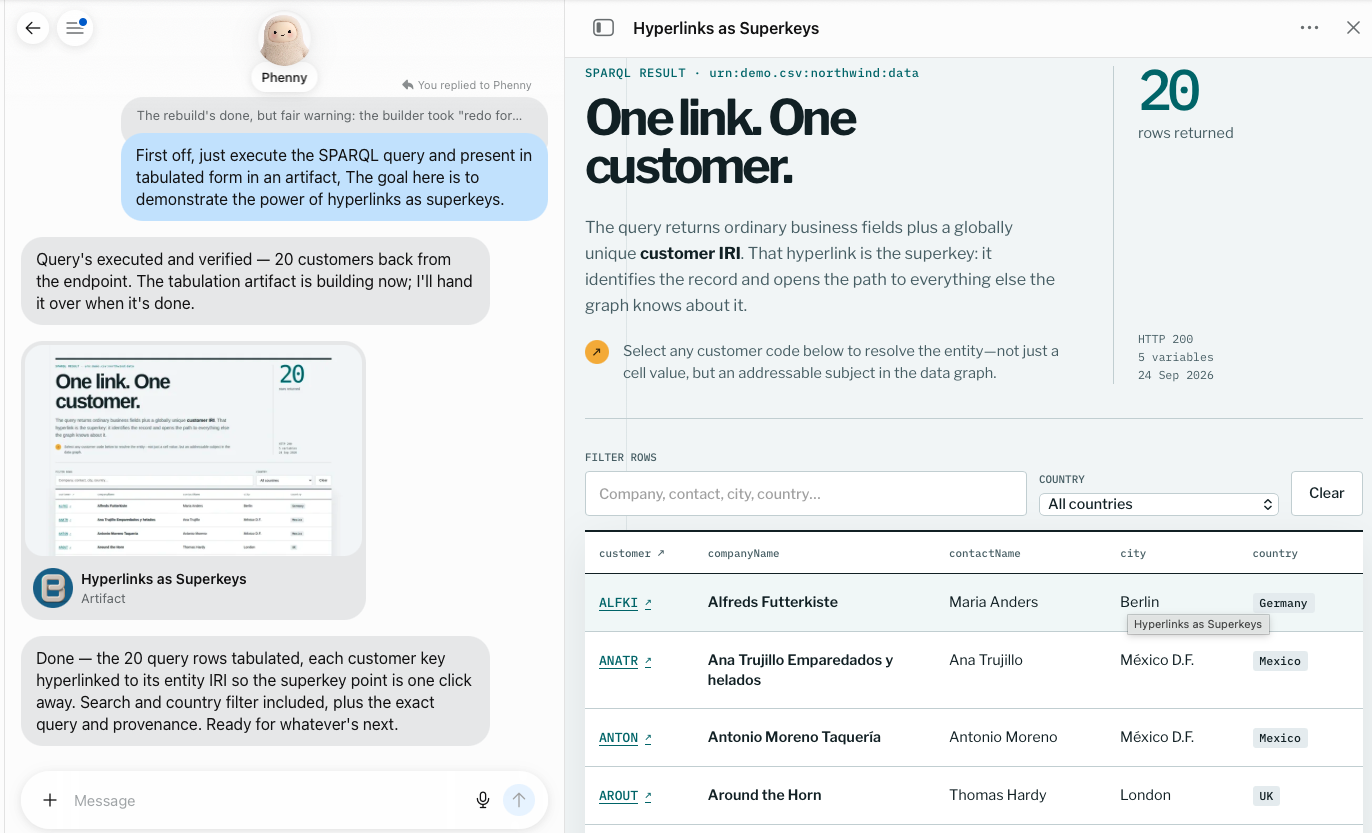
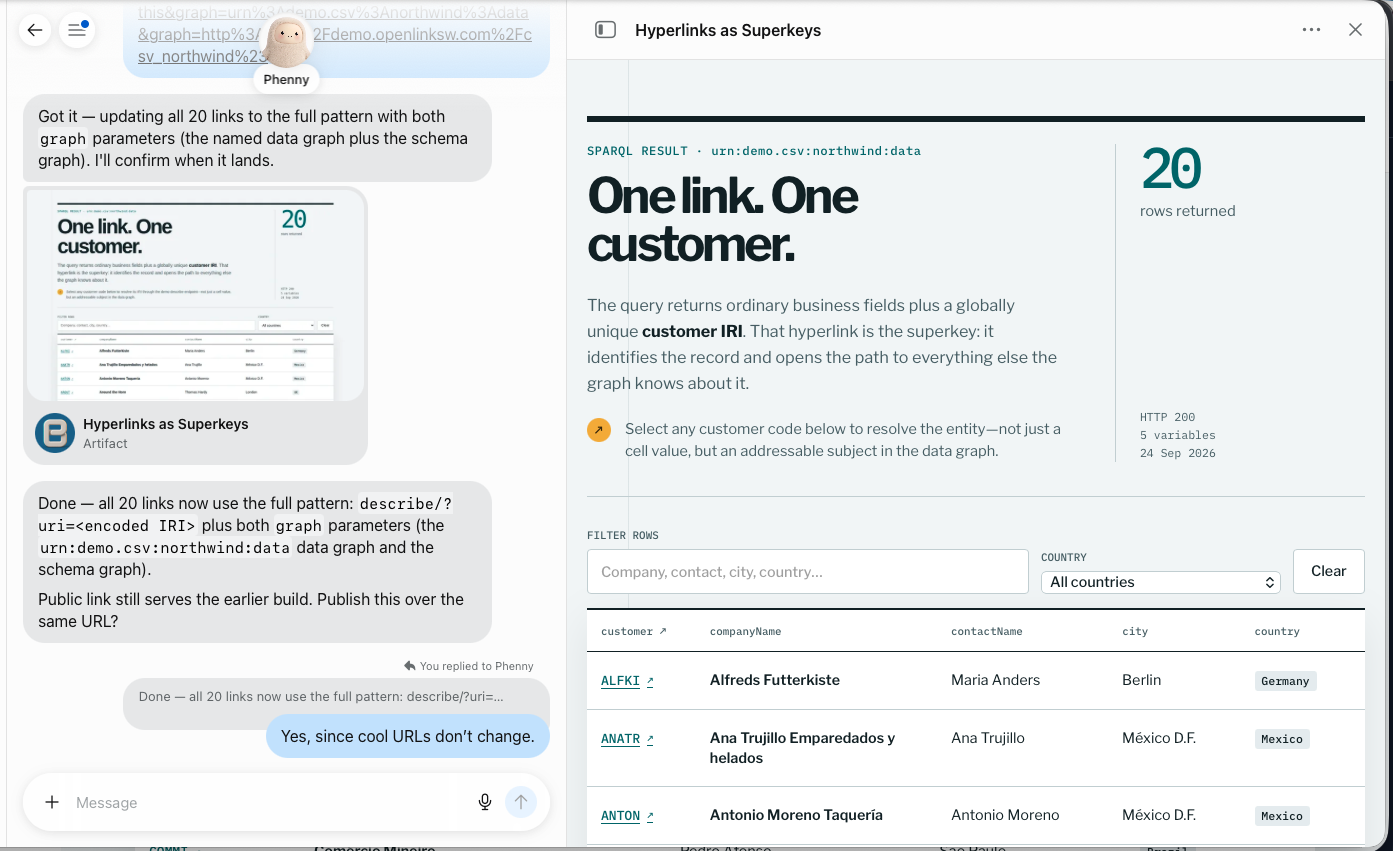
The agentic-era artifact exists: the NorthwindKG Reactive Dashboard, a reactive HTML dashboard generated from the Northwind Knowledge Graph. Open the live dashboard.
Apps and Connectivity Over Eras
The era infographic that anchors the essay — full width, click to inspect.
Ingredients of Escape Velocity
What an agent actually needs before the GUI's gravity stops mattering.
Attribute-Based Access Control
Agents touch any data only subject to policy. ABAC turns openness from a risk into an architecture — access decided by attributes, not by which app you bought.
SPARQL
One declarative language over the graph. If the agent can ask it, the agent can use it — no per-application API to learn.
RDF
Subject-predicate-object triples with global identifiers. Data that describes itself travels further than data that needs its app.
ontologies
Formal vocabularies so agent and data agree on what a customer, an order, or a price is — the semantic contract behind every query.
hyperlinks
Entities resolve to more entities. The web's original superpower, finally usable by software that can follow a link.
URIs
Every thing gets a name that outlives the application. Identity that survives decoupling is what makes the graph composable.
The Inversion
The stack, read backwards.
Before
The application sits between the human and the data, and the GUI is the toll booth.
After
The agent sits between the human and the data; the experience is an output, not a gate.
This is the essay's thesis in one diagram: generated experience is what the agent produces after the work is done — not the predetermined surface the work must pass through.
HowTo: Reach Escape Velocity
Seven steps from the essay's argument, modelled as schema:HowTo.
Name resources with URIs
Give every entity — a person, product, dataset, or capability — a globally scoped, dereferenceable name. A durable identity is the first thing an agent needs before it can act.
Express relations as RDF
Turn implications buried in prose into machine-computable entity-relationship statements. If the agent can read the triple, it never has to guess the meaning.
Traverse via Linked Data
Publish relationships so they are discoverable and followable over HTTP. The agent walks the graph instead of hunting for bespoke APIs.
Add ontological context
Supply shared semantics: what each entity is, how entities relate, what constraints apply. Ontologies turn bare triples into understanding the agent can reason with.
Expose tools via MCP
Wrap capabilities as agent-accessible tools and resources. Data answers the agent's questions; tools let it perform actions.
Govern via identity and ABAC
Let identity, attributes, context, and policy decide which agent may do what, on which data. Governance is what makes agency safe to delegate.
Let the agent generate the experience
The GUI is the last coupling to shed. When visual interaction helps, the agent generates the interface for the task at hand — then discards it.
FAQ
Twelve named questions, twelve named answers — each question heading is its entity.
F01What does “escape velocity” mean here?
The point where productive interaction no longer depends on a predetermined graphical interface. The data persists, the capabilities persist — and the experience is generated per task instead of pre-built per application. Like orbital mechanics: with enough momentum, the old gravity well stops defining the trajectory.
F02Why didn’t the Web carry native-app productivity forward?
There was no Web-native equivalent of Microsoft Access — no open, HTTP-era successor that carried relational data, forms, reports, and ad hoc visual work into one network-native tool. HTML, CSS, JavaScript, and frameworks could recreate the experience, but every recreation was custom work. Connectivity advanced; everyday interface-making regressed.
F03What is “progressive decoupling”?
The article’s through-line: each era removed one assumption about where applications or data had to live. ODBC decoupled the database; UDBC and iODBC decoupled the operating system; Java and JDBC decoupled the runtime; CORBA decoupled distributed objects; HTTP decoupled resource location; MCP decouples agent tools. AI agents decouple the experience itself from the predetermined GUI.
F04How do CORBA and MCP relate?
They attack the same problem — how software invokes capabilities in a loosely coupled manner — through different interaction models. CORBA used distributed object interoperability: Application → Object Interface → Distributed Capability. MCP exposes capabilities as agent-accessible tools and resources: Agent → Tool Interface → Distributed Capability. Same architectural requirement; the interaction model changes.
F05What changes in the interaction model with AI agents?
The Web era’s dominant model — Human → GUI → Application → Data + Actions — becomes Human → Agent → Governed Data + Tools → Actions. Agents don’t merely retrieve information; they do things. And when a GUI would be useful, the agent generates one: the GUI moves from gateway to generated artifact.
F06What does an agent need to act on a user’s intent?
Appropriate identity, authorization, context, skills, and tools. It must identify the resource, understand what it represents, determine its relationships, discover appropriate capabilities, and obtain authorized access to the data and actions the task requires.
F07Why does the Semantic Web project matter to AI agents?
Agents are ravenous for context. The questions an agent must answer — what is this entity, what type of thing is it, how does it relate to another, what constraints apply, who may access it, what capabilities are available — are precisely the questions the Semantic Web project addressed. HTTP gives connectivity; URIs give names; RDF gives machine-computable representation; Linked Data makes it traversable; ontologies supply shared meaning.
F08What are the ingredients of escape velocity?
Six, per the article: HTTP for connectivity; URIs for globally scoped names; RDF for machine-computable entity-relationship representation; Linked Data for discoverable, traversable relationships; ontologies for machine-computable context; and MCP to expose tools and capabilities to the agentic layer. The Web gave us an interconnected document network; these ingredients build the entity-relationship graph on top of it.
F09What does “the GUI moves from gateway to generated artifact” mean?
The inversion at the article’s center. The GUI doesn’t disappear — its role changes. Instead of Human → GUI → Application → Data + Actions, we get Human → Agent → Governed Data + Tools → Actions, plus Agent → Generated Experience when visual interaction helps. The data persists. The capabilities persist. The experience becomes disposable.
F10What does the Northwind example prove?
That one database tells the whole story. Pre-Web: Northwind Data → Native Application → Productive GUI — Access’s rich front end, ODBC reaching SQL Server and Excel. Web: Northwind Data → Web Stack → Custom Web Application — connectivity without the native-app productivity carried forward. Agentic: Northwind Data + Tools → Agent → Task-Specific Experience + Actions — the NorthwindKG Reactive Dashboard, generated by an AI agent, is the outcome rather than the starting point.
F11Do people still need to learn SPARQL or RDF?
No — that is the point. Humans don’t need to write SPARQL, understand RDF, inspect database schemas, or study tool definitions before accomplishing a task. The agent works with governed, machine-computable resources and tools on their behalf, and generates the experience when visual interaction helps. Humans express intent; agents deal with the machinery.
F12What governs an agent’s access?
Identity, attributes, context, and policy — including Attribute-Based Access Control. Documents are data containers managed by filesystems, database systems, or hybrids of both; tools provide action-oriented capabilities. The agent’s reach is bounded by authorization, not by which application’s GUI happens to be open.
Glossary
Twelve defined terms, each linked to its canonical home.
HTTP
Hypertext Transfer Protocol. The Web’s generic application protocol: it made resources globally reachable across networks, and its original connectivity is what agents are now restoring.
URI
Uniform Resource Identifier. Globally scoped names for resources — the addressing layer that lets anything, including entities inside documents, be named and reached.
HTML
HyperText Markup Language. Supplied structure for the browser-era application experience, with CSS for presentation and JavaScript for behavior.
RDF
Resource Description Framework. Machine-computable entity-relationship representation — the Semantic Web’s answer to “what relates to what”.
Linked Data
The practice of publishing structured, interlinked data so that relationships are discoverable and traversable over HTTP — follow-your-nose, for machines.
Ontology
A shared semantic model — classifications, relationships, and constraints — that gives machines computable context for what entities mean.
SPARQL
The query language for RDF graphs. The agent’s way of asking the entity-relationship graph questions no human has to formulate.
ABAC
Attribute-Based Access Control. Access decisions driven by identity, attributes, context, and policy — the governance layer for agentic data access.
ODBC
Open Database Connectivity. The API that loosened the coupling between Windows applications and database management systems.
iODBC
Independent ODBC. The cross-platform ODBC environment born when OpenLink’s UDBC fused with Ke Jin’s Driver Manager and Administrator layers.
CORBA
Common Object Request Broker Architecture. The OMG’s distributed-object answer to invoking capabilities across networked systems in a loosely coupled way.
MCP
Model Context Protocol. The standardized mechanism connecting AI applications and agents to the external tools, resources, and capabilities their tasks require.
KG Explorer
Interactive visualization of this collection's knowledge graph. Node labels sit below their circles; click a node to open it in the resolver.
⚙ Advanced Settings
SPARQL Workbench
Run live SPARQL queries against the companion knowledge graph. Recipes open closed by default.
Sample queries from the graph
Entity-type summary (canonical)
SAMPLE-based per-type census of the collection graph: type, one sample entity, its label, and the count — ordered by frequency.
PREFIX rdf: <http://www.w3.org/1999/02/22-rdf-syntax-ns#>
PREFIX rdfs: <http://www.w3.org/2000/01/rdf-schema#>
PREFIX schema: <http://schema.org/>

SELECT
    ?type
    (SAMPLE(?s) AS ?sampleEntity)
    (SAMPLE(?label) AS ?sampleLabel)
    (COUNT(?s) AS ?entityCount)
WHERE {
    GRAPH <https://linkeddata.uriburner.com/DAV/demos/daas/semantic-web-escape-velocity-muse.ttl> {
        ?s rdf:type ?type .
        OPTIONAL { ?s rdfs:label ?label }
    }
}
GROUP BY ?type
ORDER BY DESC(?entityCount)
The three eras and what each sheds
Every HistoricalEra with its description — the Pre-Web, Web, and Agentic eras the essay compares.
PREFIX schema: <http://schema.org/>
PREFIX : <https://community.openlinksw.com/t/semantic-web-vision-escape-velocity-via-ai-agents/6512#>

SELECT ?era ?name ?description
WHERE {
    GRAPH <https://linkeddata.uriburner.com/DAV/demos/daas/semantic-web-escape-velocity-muse.ttl> {
        ?era a :HistoricalEra ;
             schema:name ?name ;
             schema:description ?description .
    }
}
ORDER BY ?name
Decoupling stages in launch order
The seven stages from ODBC to AI agents, each with the coupling it sheds.
PREFIX schema: <http://schema.org/>
PREFIX : <https://community.openlinksw.com/t/semantic-web-vision-escape-velocity-via-ai-agents/6512#>

SELECT ?stage ?name ?sheds
WHERE {
    GRAPH <https://linkeddata.uriburner.com/DAV/demos/daas/semantic-web-escape-velocity-muse.ttl> {
        ?stage a :DecouplingStage ;
               schema:name ?name ;
               :shedsCoupling ?sheds .
    }
}
ORDER BY ?name
FAQ questions with their answers
All twelve named questions joined to their accepted answers.
PREFIX schema: <http://schema.org/>

SELECT ?question ?answer
WHERE {
    GRAPH <https://linkeddata.uriburner.com/DAV/demos/daas/semantic-web-escape-velocity-muse.ttl> {
        ?q a schema:Question ;
           schema:name ?question ;
           schema:acceptedAnswer ?a .
        ?a schema:text ?answer .
    }
}
ORDER BY ?questionAbout This Page
This page was generated from the forum essay “Semantic Web Vision: Escape Velocity via AI Agents” (community.openlinksw.com, topic 6512). RDF-Turtle was generated via the kg-generator and rdf-infographic-skill skills, curated by Muse Spark on behalf of Kingsley Idehen.
Turtle is the source of truth. JSON-LD is generated from it with rdflib and is semantically equivalent.
Curated on behalf of Kingsley Idehen. This collection names no author: the source essay names none, and none is fabricated.
“Semantic Web Vision: Escape Velocity via AI Agents” (community.openlinksw.com, topic 6512) — the forum essay this collection is built from.
Generated by Muse Spark (Muse Spark 1.3, Meta) via a deterministic Python build script kept at ~/workspace/scripts/semantic-web-escape-velocity-build.py.
Semantic links use URIBurner describe; live queries target URIBurner SPARQL over OpenLink Virtuoso. The KG Explorer uses D3.js.
https://linkeddata.uriburner.com/DAV/demos/daas/semantic-web-escape-velocity-muse.ttl
Visible semantic links route through https://linkeddata.uriburner.com/describe/?url={encodedIRI}.
RDF and HTML generated from the source essay above via the kg-generator and rdf-infographic-skill skills, curated by Muse Spark on behalf of Kingsley Idehen.